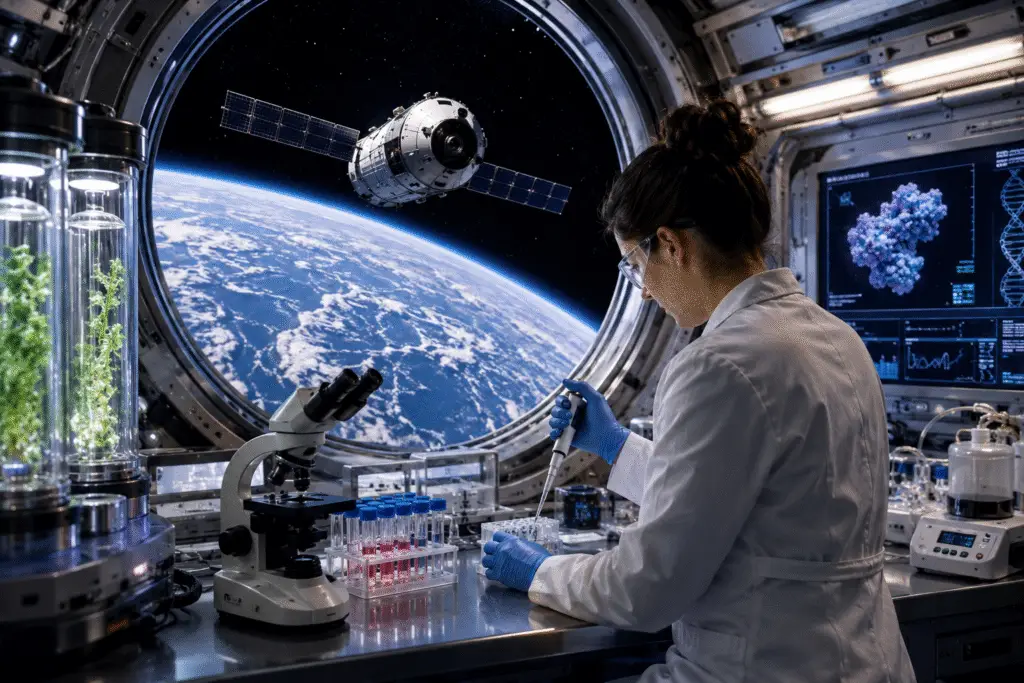


Clinical trials in orbit are beginning to reshape conversations around the future of healthcare, drug discovery, and medical research. As scientists study how biology behaves in microgravity aboard space stations like the International Space Station, researchers are discovering new ways to explore disease, accelerate early stage drug development, and better understand the human body beyond Earth.
A few months ago, I worked on a school project related to space research that was selected to be reviewed aboard the International Space Station.
That experience changed how I think about science.
Until then, space felt distant something about rockets, astronauts, and exploration. But through that project, I started to see space differently: as a laboratory. A place where the rules of biology change, and where those differences might actually help us solve problems back on Earth.
Since then, I’ve been thinking about a simple but powerful question:
If biology behaves differently in space, could that help us rethink how we develop medicines?
In space, everything exists in microgravity, meaning objects and even cells experience near weightlessness.
At first, this sounds like a limitation. But in biology, it’s actually an opportunity.
In microgravity:
• Cells grow and interact differently
• Fluids don’t settle the same way
• Proteins can form more precise structures
Research supported by organizations like NASA has already shown that these differences can lead to:
• Better protein crystallization (important for drug design)
• Faster stem cell growth
• New insights into cancer behavior
• Models for aging related conditions like bone loss
These aren’t just interesting observations. They could change how we approach disease.
Clinical trials today are incredibly complex. They take years, cost billions, and often fail in later stages.
That’s what makes microgravity so interesting.
In space, researchers can:
• Observe biological processes more clearly
• Study diseases in ways not possible on Earth
• Potentially identify drug targets faster
This led me to think:
What if space could help us speed up the early stages of clinical research?
To be clear, we’re not at a point where patients are going to space for trials. But microgravity research could transform the earlier phases where understanding biology is the biggest challenge.
This isn’t just theoretical.
Experiments on platforms like the International Space Station are already exploring:
• Cancer treatments
• Neurodegenerative diseases
• Immune system behavior
At the same time, private companies like Axiom Space and SpaceX are making space more accessible for research.
Still, most of this work is early stage focused on understanding biology, not running full clinical trials.
As exciting as this is, there are real limitations.
• Cost: Sending experiments to space is still expensive
• Scale: Clinical trials need large populations something space can’t yet support
• Logistics: Running controlled experiments in orbit is complicated
• Regulation: There’s no clear framework for clinical trials beyond Earth
These challenges make it clear that space won’t replace Earth based trials anytime soon.

What surprised me most while exploring this topic wasn’t the science. It was the lack of discussion around policy and ethics.
If clinical research moves into space:
• Who regulates it?
• Which country’s laws apply?
• Who owns the data?
• Who gets access to these advancements?
There’s also a bigger concern:
Will space based medicine benefit everyone or only those who can afford it?
As private companies become more involved, these questions become even more important.
The more I read, the more I realized that the future is probably not about choosing between Earth and space but combining both.
A possible model could be:
• Early stage research in microgravity
• Large scale trials on Earth
• Continuous feedback between both environments
This kind of system could make drug development faster and more precise.
Before this project, I never thought of space as something connected to healthcare.
Now, it feels like one of the most interesting frontiers not just scientifically, but socially and politically.
We’re entering a phase where:
• Biology is being studied beyond Earth
• Medicine could become multi environmental
• Innovation is no longer limited by gravity
This topic started as a school project. But it quickly became something more a way of thinking about how different fields connect.
Space is often seen as exploration for its own sake. But what interests me more is this:
How can space help us solve real problems on Earth?
Clinical trials in orbit may still be in the early stages, but they represent a bigger idea that innovation doesn’t have to be confined to where we are.
And as we push further into space, the real challenge won’t just be scientific.
It will be making sure that what we discover up there actually helps people down here.
Read more healthcare innovation articles here.

Kabir Nott is an 11th-grade student at the Singapore American School with a strong interest in the intersection of space research, healthcare, and public policy. His curiosity deepened after contributing to a school project that was selected for review by the International Space Station, sparking a sustained interest in how microgravity research can address real-world challenges on Earth.
Alongside his academic pursuits, Kabir is a jazz musician and actively explores ways to use music for community impact, particularly in healthcare and mental well-being.