


Movement is often where wellness can become performance.
Tracking the steps. Closing the rings. Burning the calories.
Movement does not always need to be measured to matter. Sometimes the body does not need another goal.
This month, we are not using movement to: prove discipline…by pushing and punishing your body or chasing a number! No–we are simply practicing movement as reconnection to your body.
Some movement is better than none.
Some movement is better than none.
Some movement is better than none.
Movement does not have to be intense to count.
Research consistently shows that physical activity supports cardiovascular health, metabolic health, mood, sleep, and overall well-being (World Health Organization; Centers for Disease Control and Prevention).
That can look like: small realistic activity completed across the week..like walking, stretching, or intentionally breaking up long periods of sitting. A small active goal is still supportive of your body’s circulation, mobility, energy, and long-term health.
A systematic review and meta-analysis by Chastin et al. found that light-intensity physical activity may play a role in improving adult cardiometabolic health and reducing mortality risk (Chastin et al.).
AND
There is also emerging research showing that tracking performance metrics can affect how people feel about their movement. For some, numbers are motivating. For others, especially during stressful seasons, numbers can become another source of pressure. In a longitudinal randomized controlled trial, Zahrt et al. found that wearable fitness trackers and beliefs about activity adequacy could influence people’s affect, behavior, and health perceptions (Zahrt et al.).
That means two things:
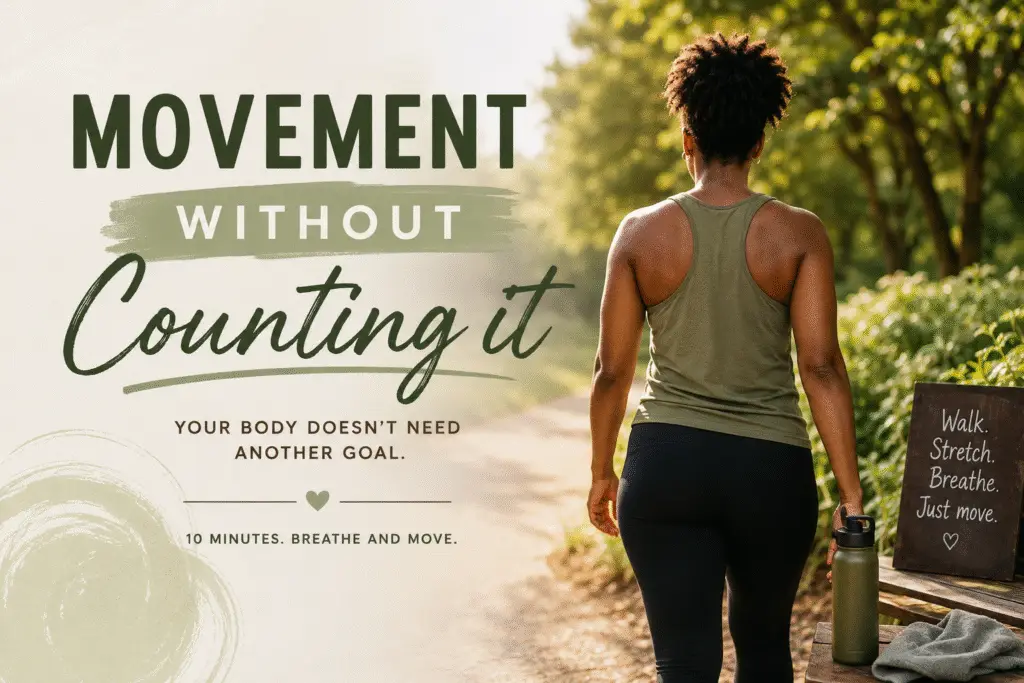
Move your body for 10 minutes. That’s it.
Not as a challenge.
Not as a fitness plan.
Walk, stretch, sway, clean, breathe, roll your shoulders, or move your body slowly. No tracking steps, pace, etc.
10 minutes. Breathe and move.
The goal is not to “get a workout in”
The goal is to notice what your body feels like when movement is not being judged.
Movement supports circulation, mobility, mood, and energy regulation. It can help the body shift out of stress, stillness, or stagnation without requiring a full workout.
When you move without measuring, you create space to experience movement from the inside instead of evaluating it from the outside.
This is body literacy.
Small movement still counts.
Movement without performance still counts.
Let that be enough.
Chastin, Sebastien F. M., et al. “How Does Light-Intensity Physical Activity Associate with Adult Cardiometabolic Health and Mortality? Systematic Review with Meta-Analysis of Experimental and Observational Studies.” British Journal of Sports Medicine, vol. 53, no. 6, 2019, pp. 370–376.
World Health Organization. “Physical Activity.” World Health Organization, 26 June 2024.
Zahrt, Octavia Hedwig, et al. “Effects of Wearable Fitness Trackers and Activity Adequacy Mindsets on Affect, Behavior, and Health: Longitudinal Randomized Controlled Trial.” Journal of Medical Internet Research, vol. 25, 2023, e40529.