

By Kabir Nott
Medicine Developed in Space may sound like science fiction, but it is quickly becoming a real scientific and policy challenge. As researchers explore pharmaceutical manufacturing in microgravity, an important question emerges: Who regulates medicine developed in space?
A few months ago, I wrote about the possibility of conducting clinical research in orbit.
At the time, I was fascinated by the science. Could microgravity help us understand disease differently? Could it accelerate drug discovery? Could space become an extension of the laboratory rather than simply a destination for exploration?
The more I researched those questions, the more another question kept appearing.
Not a scientific question.
A policy question.
At first, I assumed there must already be an answer. After all, we have regulators for medicines, regulators for aircraft, regulators for clinical trials, and regulators for commercial spaceflight.
Surely someone is responsible.
The deeper I looked, the less certain I became.
Imagine a future that may be closer than we think.
A pharmaceutical company develops a new treatment using a manufacturing process that only works in microgravity.
The research team is based in Boston.
The manufacturing takes place aboard a commercial spacecraft orbiting Earth.
The capsule returns through a privately operated reentry vehicle.
The final product is sold globally.
Whose rules apply?
Is it the responsibility of the FDA because it is a medicine?
Is it the responsibility of a national space agency because it was produced in orbit?
Does the country that launched the spacecraft have authority?
Or does space itself require an entirely new regulatory framework?
The interesting thing is that these questions are no longer theoretical.
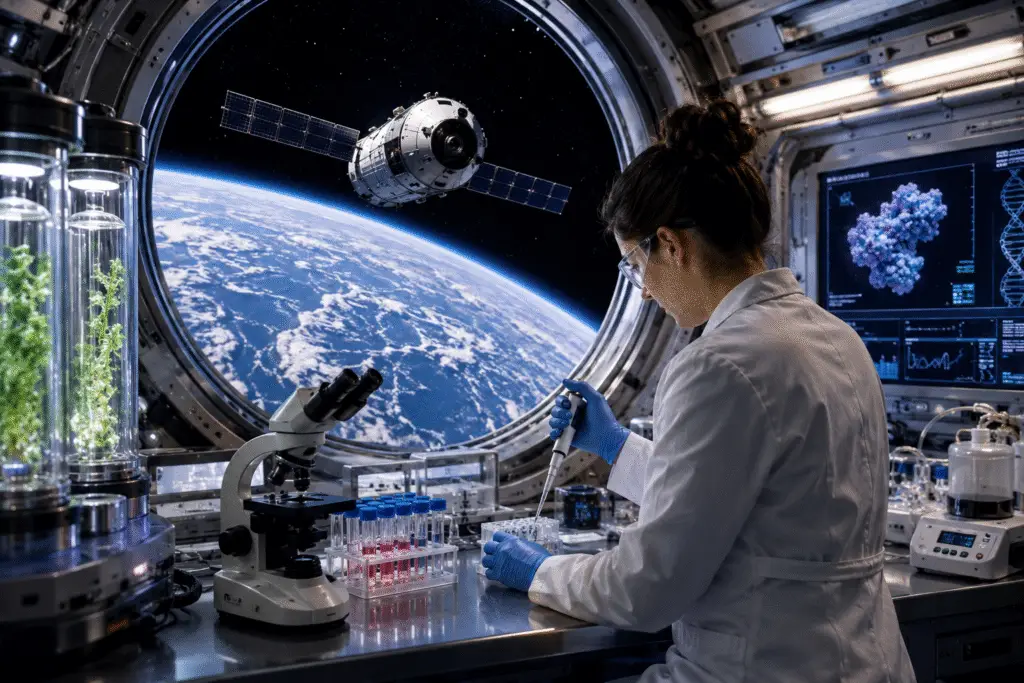
Companies are already exploring pharmaceutical manufacturing in orbit. Researchers are using the International Space Station to study cancer, aging, protein crystallization, and stem cell growth in microgravity. Meanwhile, commercial space stations and private research platforms are being planned for the coming decade.
The science is advancing.
The governance is still catching up.
What struck me while researching this topic is that history has seen this pattern before.
The internet transformed society before governments fully understood how to regulate it.
Artificial intelligence is following a similar trajectory today.
Space biotechnology may be next.
In many ways, the challenge is not about whether medicines can be developed in space. It is about whether our institutions are prepared for a future in which parts of the healthcare system exist beyond Earth.
The current regulatory landscape was built around a simple assumption: research happens on Earth, manufacturing happens on Earth, and patients receive treatment on Earth.
Space changes all three assumptions.
Consider a biological sample collected in orbit.
Who owns the data?
Who has the right to access it?
If a new drug is discovered using experiments conducted in microgravity, who owns the intellectual property?
More importantly, who benefits?
As someone interested in both science and policy, I find these questions just as compelling as the science itself.
Because history suggests that technological breakthroughs do not automatically create public benefit.
Institutions matter.
Rules matter.
Governance matters.
Perhaps the most important lesson from studying space biotechnology is that the future will not be shaped only by scientists and engineers.
It will also be shaped by policymakers, ethicists, regulators, physicians, entrepreneurs, and citizens who decide how these technologies should be used.
The question is no longer whether humanity will take biotechnology into space.
The question is whether we can build the frameworks needed to ensure that what we discover up there ultimately benefits people down here.
And for a field that may one day redefine medicine, that conversation is only beginning.

Kabir Nott is an 11th-grade student at the Singapore American School with a strong interest in the intersection of space research, healthcare, and public policy. His curiosity deepened after contributing to a school project that was selected for review by the International Space Station, sparking a sustained interest in how microgravity research can address real-world challenges on Earth.
Alongside his academic pursuits, Kabir is a jazz musician and actively explores ways to use music for community impact, particularly in healthcare and mental well-being.