


By Abel Vissoukpo
Why successful clinical trial start-up depends on operational readiness, risk identification, and sustainable site support.
A clinical trial site may look ready on paper and still struggle when the study begins.
The feasibility questionnaire is complete. The principal investigator has relevant experience. The hospital has the required departments, and the study coordinator appears familiar with clinical research procedures.
Yet, after site activation, recruitment may progress more slowly than expected, essential documents may be incomplete, source data may be difficult to verify, or laboratory and investigational product logistics may create unexpected delays.
These challenges raise an important question: Are we assessing whether a site meets the feasibility criteria, or whether it can reliably deliver the trial under real operational conditions?
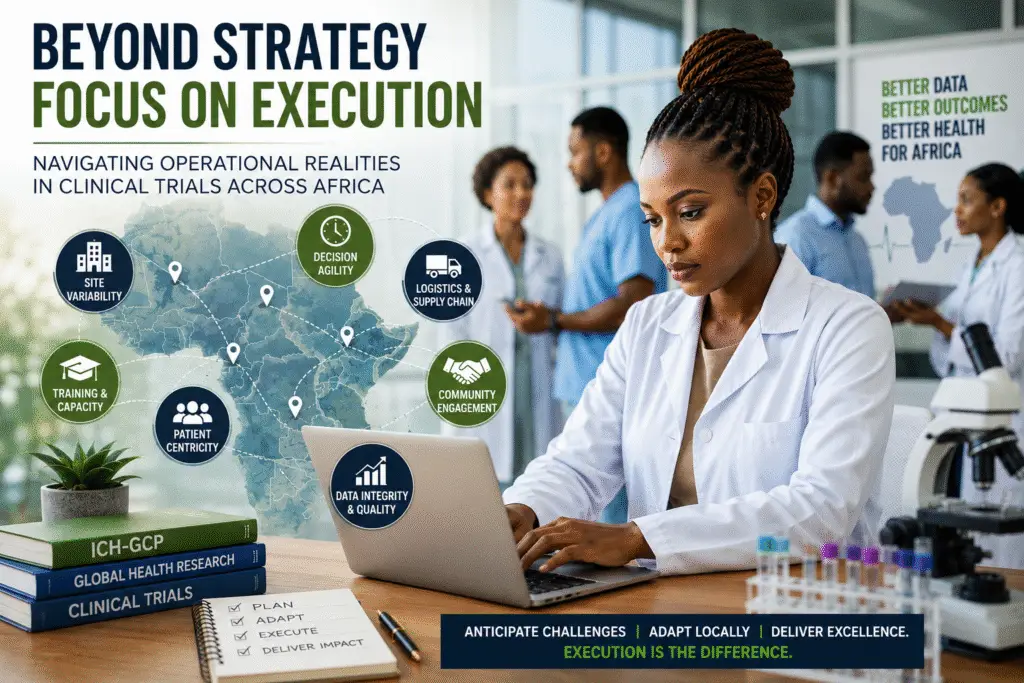
Across Africa, where clinical research capabilities and healthcare infrastructure vary considerably between institutions, this distinction deserves particular attention. Abel explored the wider execution challenges in his earlier article, Navigating Operational Realities in Clinical Trials Across Africa.
Site readiness should therefore be understood as an ongoing assessment of a site’s ability to protect participants, follow the protocol, maintain reliable data, and manage the practical demands of a specific clinical trial.
Feasibility questionnaires remain valuable tools for collecting information about patient populations, investigator experience, infrastructure, staffing, and competing studies.
However, most questionnaires depend substantially on reported information. A positive response does not always demonstrate that a process works consistently in practice.
For example, a site may confirm that it has trained personnel, but this does not establish whether responsibilities are clearly delegated, whether staff understand study-specific procedures, or whether adequate coverage exists during absences.
Similarly, access to a laboratory does not automatically confirm that sample processing, storage, transport, and result reporting can meet the protocol’s requirements.
The distinction is important because operational weaknesses can remain hidden until recruitment or study activities begin.
A stronger feasibility assessment combines documented information with targeted discussions, process walkthroughs, and verification of critical capabilities.
The objective is not to make site selection unnecessarily complicated. It is to identify the conditions that could affect participant safety, data reliability, and study timelines before they become more difficult to address.
The principal investigator’s qualifications are essential, but successful trial delivery also depends on the wider team.
Investigators, sub-investigators, study coordinators, pharmacists, laboratory personnel, and other delegated staff must understand their responsibilities and have sufficient time and resources to perform them.
During feasibility assessment, sponsors and CROs should examine:
A useful question is whether the site can maintain continuity if a key coordinator leaves or the investigator’s availability changes.
A site that depends heavily on one individual may require a continuity plan before activation.
Infrastructure should be evaluated in relation to the actual requirements of the protocol.
The presence of consultation rooms, laboratory equipment, secure storage, or electronic data systems is only part of the assessment. The relevant question is whether these resources are available, suitable, maintained, and accessible when needed.
Depending on the study, assessment may include:
In resource-constrained settings, contingency planning is particularly important. Electricity interruptions, connectivity problems, transport disruptions, or delays in obtaining supplies may affect study continuity.
These risks should be assessed proportionately to their potential consequences rather than treated as identical across all sites.
Recruitment projections should reflect the site’s actual patient flow and the eligibility criteria of the protocol.
A large patient population does not necessarily translate into a large pool of eligible participants. Referral patterns, competing studies, clinical workload, visit frequency, and participants’ practical circumstances can influence recruitment and retention.
Feasibility discussions should therefore explore the anticipated number of eligible patients, the process for identifying potential participants, and the resources required to complete screening and follow-up.
In some African settings, distance to the site, transport costs, work commitments, and competing family responsibilities may affect attendance. These factors should be assessed locally rather than assumed to apply equally to every population.
A realistic recruitment plan should document its assumptions and identify potential barriers before the first participant is enrolled.
The goal is to develop a credible plan that supports informed participation and protocol compliance, rather than an ambitious target that places avoidable pressure on the site team.
Data quality begins with the processes used to generate and document information.
A site may have an electronic case report form (eCRF) and an experienced data-entry team, yet still encounter recurring queries if source documentation is incomplete, delayed, or inconsistent.
During readiness assessment, it is useful to examine how clinical observations and study-specific procedures are documented, how source records are maintained, and how discrepancies are identified and resolved.
Investigators and delegated staff should understand the relationship between source documentation and CRF entry, including the need for traceability and consistency with the protocol.
Sponsors and CROs should also assess whether the site has practical procedures for handling missing data, correcting errors, responding to queries, and maintaining essential records.
These discussions can reveal training needs that may not be apparent from certificates or completed training logs alone.
Regulatory and ethics approvals are essential prerequisites, but readiness also requires the ability to maintain compliance throughout the study.
The site should understand the applicable approval conditions, informed consent requirements, safety reporting responsibilities, protocol deviation management, and essential document maintenance.
For studies conducted across multiple African countries, differences in national regulatory requirements and ethics review processes must be incorporated into the start-up plan.
A clear responsibility matrix can help sponsors, CROs, investigators, and local teams understand who is responsible for each submission, follow-up action, and required record.
The operational objective is to identify dependencies early and prevent avoidable delays while maintaining the protection of participants.
Identifying a gap has limited value unless the finding leads to an appropriate action.
A useful approach is to translate feasibility findings into a site readiness action plan before activation.
For each identified gap, the plan should specify:
Consider a site that has access to laboratory services but lacks a documented process for transporting study samples within the protocol’s required time window.
The appropriate response is not simply to record the gap. The site and sponsor should clarify responsibilities, establish a workable transport process, confirm that the relevant personnel understand it, and verify that the arrangements meet protocol requirements before the affected activities begin.
Not every gap requires the same response. Some can be resolved through targeted training or procedural clarification; others may require additional resources or a reassessment of site suitability.
Where a gap affects participant safety, regulatory compliance, or the reliability of critical trial data, the decision to proceed should be based on documented evidence that the risk has been adequately addressed.
Site activation is an important milestone, but it does not, by itself, demonstrate operational readiness.
Sponsors and CROs can improve their assessments by tracking a small set of meaningful indicators, adapted to the study’s risks and requirements.
Examples include:
These indicators should be interpreted in context. A low recruitment rate, for example, may reflect unrealistic initial assumptions, changes in patient availability, or other factors that require investigation. It should not automatically be interpreted as poor site performance.
Similarly, the number of completed readiness actions is less informative than whether the actions addressed the underlying risks.
A balanced assessment combines quantitative indicators with professional judgment and direct engagement with the site team.
Site assessment should create an opportunity for collaboration between sponsors, CROs, investigators, and local research teams.
When gaps are identified, the objective should be to understand their causes and determine what support is needed. Depending on the circumstances, this may include protocol-specific training, mentoring, improved documentation processes, clearer communication channels, or practical solutions to logistical constraints.
This approach is particularly relevant where research teams have varying levels of experience or limited access to sustained capacity-building opportunities.
Strengthening local research capacity requires more than preparing a site for one study. It involves developing processes, competencies, and quality practices that can support future research as well.
Sponsors and CROs also have a role in ensuring that study expectations are realistic and that the resources provided are proportionate to the protocol’s operational demands.
A collaborative readiness process can help identify weaknesses early while supporting the long-term development of research sites.
Clinical trial site readiness should not be reduced to a completed questionnaire, a list of available facilities, or a collection of qualification certificates.
It requires evidence that the site can perform the activities demanded by the specific protocol, protect participants, maintain reliable records, and respond effectively when operational challenges arise.
For clinical research across Africa, this means combining structured feasibility assessment with a practical understanding of local healthcare systems, site capabilities, patient pathways, and logistical constraints.
The ICH E6(R3) Good Clinical Practice framework reinforces the importance of appropriate investigator and site capabilities, participant protection, reliable data, and quality approaches proportionate to trial risks.
Ultimately, the purpose of a readiness assessment is not to identify a perfect site. It is to determine whether a site is suitable for the study, understand the risks that remain, and ensure that appropriate measures are in place before trial activities begin.
The key question for sponsors and CROs is straightforward: What evidence demonstrates that a site is ready to conduct this specific trial safely and reliably?
Moving beyond the questionnaire toward evidence-based, risk-informed readiness assessments can support better start-up decisions, more effective site partnerships, and stronger clinical research delivery.
Related reading: Navigating Operational Realities in Clinical Trials Across Africa: Beyond Strategy, Focus on Execution by Abel Vissoukpo.

Abel Vissoukpo is a Clinical Research Associate (CRA) & Public Health Researcher who is passionate about transforming clinical research and public health projects into GCP-compliant, patient-centered, and data-driven outcomes. With solid experience across Clinical Research Operations, Healthcare Project Coordination, and Monitoring he is focused on delivering high-quality research, ethical practices, and measurable impact.
Over the years, Abel has coordinated and contributed to health and clinical research projects benefiting over 500 patients, implementing digital and AI-driven solutions that improved project efficiency by 30%.