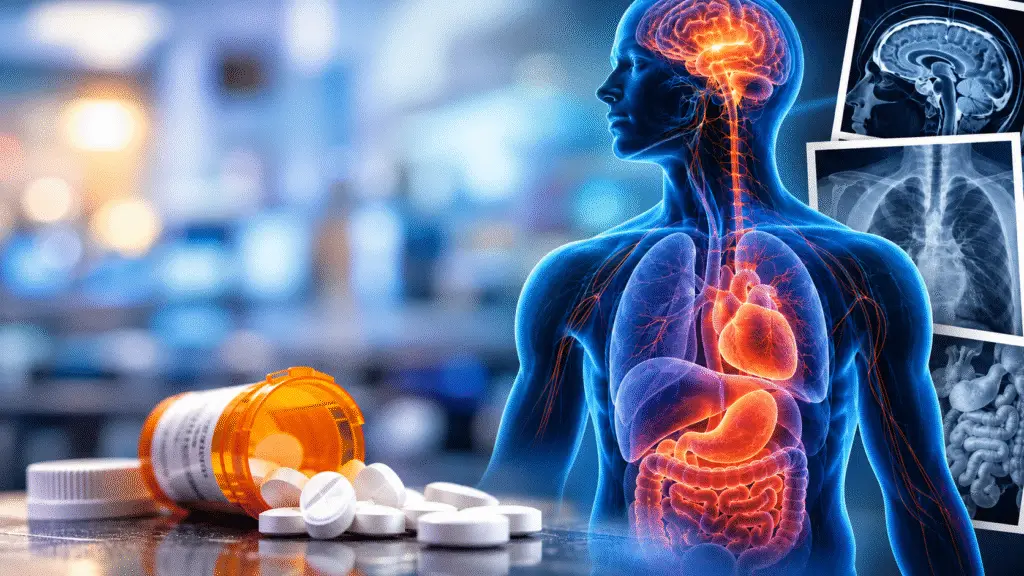


Opioids are chemicals that interact with opioid receptors on the nerve cells in the body and brain to reduce feelings of pain. These medications are classified as natural, chemically modified forms of naturally occurring, and synthetic. Examples of naturally occurring opiates are codeine, opium, and morphine (Bishop et al 2018). Heroin, hydromorphone, hydrocodone, and oxycodone are examples of chemically changed formed opiates (Bishop et al 2018). The synthetic opioids are made in laboratories to mimic the properties of natural opioids (APA 2020). These synthetic opiates are demerol, methadone, propoxyphene, tazocine, and fentanyl (Bishop et al 2018).
Opioids have a high abuse potential due to their ability to produce euphoria and reduce the feeling of pain. Prescription opioids are used to treat both acute and chronic pain, active-phase cancer treatment, palliative care, and hospice care. Many people rely on prescription opioids to help manage their conditions under the care of a physician (APA 2020). However, chronic use of opioids may lead to physical and psychological dependence (Bishop et al 2018).
In 2017, more than 72,000 Americans died from drug overdoses (APA 2020). The sharpest increase involved synthetic opioids such as fentanyl, resulting in 30,000 overdose deaths, according to the Centers for Disease Control and Prevention (APA 2020). The opioid crisis was declared a nationwide public health emergency on October 27, 2017 (APA 2020; Rasmussen et.al 2019).
2018 data shows that every day, 128 people in the United States die after overdosing on opioids (NIH 2020). The opioid crisis issue occurred with major consequences including increases in opioid misuse and related overdoses, negative effects on public health and the well-being of society, the increase in IV drug use resulting in diseases such as HIV and hepatitis C, and neonatal abstinence syndrome due to opioid use during pregnancy (NIH 2020).
Science can be an important part of the solution in resolving such a public health crisis (NIH 2020). The purpose of this paper is to bring awareness to the opioid crisis, examine their effects on the body, and examine how opioids cause addiction and dependence.
Opioids, which are derived from the poppy plant, made their way to the United States in 1775 through European settlers. Originally, opioids were used to treat diarrhea and pain associated with common illnesses, and they were effective in treatment (Levy 2019). Unfortunately, opioid addiction was often misunderstood and frequent in the American colonies (Levy 2019).
In the 1860s, around the time of the Civil War, the invention of the hypodermic needle, combined with opioid use, ignited a morphine epidemic (Levy 2019). As opioid addiction continued to evolve throughout the years, stigmas and fears also began to evolve. This fear resulted in doctors gravitating toward surgical procedures to block pain signals to the nerves and other non-pharmaceutical methods to relieve chronic pain.
However, in the late 1990s, pharmaceutical companies reassured the medical community that patients would not become addicted to prescription opioid pain relievers, and health care providers began to prescribe them at greater rates. This led to widespread diversion and misuse of opioids before it became clear that they truly are addictive. As a result, opioid overdose rates began to increase (NIH 2020).
Opioids and other analgesics act on mu receptors. The mu-opioid receptors are a key molecular switch for triggering brain reward systems and potentially starting addictive behaviors (Dhaliwal & Gupta 2019). To understand how individuals can become addicted to these medications, it is especially important to first understand opioids’ mechanism of action.
When an opioid is taken, the drug must leave the blood and enter the nervous system by crossing the blood-brain barrier (BBB). Smaller, lipid-soluble drugs can cross the BBB more easily than larger, less soluble drugs. For example, fentanyl is more lipid-soluble than morphine, which means that fentanyl will cause a quicker effect than morphine. Fentanyl can easily leave the nervous system, so it has a shorter duration of action.
Once inside the CNS, opioids bind to receptors found on pain-signaling neurons, causing molecular and cellular changes that prevent these neurons from sending signals to each other, stopping the person’s sensation of pain (Medicurio 2018).
The neurological basis of OUD stems from the mesolimbic reward pathway in the brain (Medicurio 2019). This pathway, also known as the dopamine mesolimbic pathway, handles motivation and is activated by rewarding, beneficial behaviors. Activation of the reward pathway is associated with a sense of pleasure and causes motivation to repeat those behaviors, setting the stage for addiction (Medicurio 2019).
Opioids can cause a large amount of dopamine to be released, creating the urge to want more of the drug and causing addiction or dependence.
The signs and symptoms of OUD include cravings, sweating, euphoria or general discontent, physical substance dependence, chronic constipation, small pupils, nausea, reduced sex drive, drugseeking behavior, shallow breathing, slurred speech, and the inability to control opioid use, even though it has negative effects on personal relationships or finances (Dhaliwal & Gupta 2019).
The Diagnostic and Statistical Manual of Mental Disorders (DSM-5) is a diagnostic tool used to assess OUD. The patient will be diagnosed with OUD if they demonstrate at least two addictive behaviors within a twelve-month period, such as taking opioids for longer than intended, craving or having a strong desire to use the drug, using opioids in hazardous situations, continuing opioid use despite interpersonal or social problems, having problems fulfilling obligations at work, and many other addictive behaviors (APA 2020).
Based on the DSM-5 criteria, there are three levels at which the healthcare provider may diagnose OUD. These levels are mild, in which the patient meets 2–3 criteria; moderate, in which the patient meets 4–5 criteria; and severe, in which the patient meets 6 or more criteria (Medicurio 2019).
Laboratory tests for opioid use consist of urine and blood screenings, in which opioid metabolites are evaluated (Ferri 2019). Initial screenings for opioids via immunoassays are also common. Immunoassay tests use antibodies to detect the presence of opioids and other substances in the body (Bishop et al 2018). Gas chromatography-mass spectrometry (GC-MS) is also used for confirmation testing of opioids (Bishop et al 2018).
Treatment for OUD is made up of two categories: nonpharmacologic therapy and medicationassisted treatment (MAT). Nonpharmacologic therapy involves brief counseling interventions with a healthcare provider, counseling services, and opioid prevention education (Ferri 2019). The FDAapproved medications for MAT are methadone, buprenorphine, and naloxone (APA 2020).
These medications work as opioid antagonists by attaching to opioid receptors to block the effects of opioids, prevent withdrawal symptoms, and reduce cravings (APA 2020). Patients taking these medications are closely monitored by their physicians via therapeutic drug monitoring.
Adolescence is a critical at-risk period for substance use. Galvan (2013) pointed out that there is a peak in reward- and sensation-seeking behaviors at 12–18 years of age. The onset of substance abuse and other psychiatric disorders occurs during adolescence, peaking at an average age of 14 years (Galvan 2013).
As the brain’s reward center continues to mature throughout the years preceding adolescence, individuals begin to discriminate more carefully between less and more meaningful rewards (Levy 2019).
To bring awareness about the opioid crisis to adolescents and young adults, my proposal is to launch a course called “Students Against Drug Use” (SADU). SADU will be added to schools’ curricula both in person and online. Students will begin taking SADU courses in elementary school and continue throughout their grade school years.
Not only will students learn about the negative effects of substance abuse, but they will also learn coping and conflict resolution skills.
The prognosis of OUD is dismal. Despite treatment and therapeutic monitoring, OUD continues to be a problem. In April 2018, U.S. Surgeon General Jerome M. Adams, M.D., M.P.H., released a public health advisory urging more Americans to carry naloxone (APA 2020).
As stated previously, naloxone is used to reverse the effects of opioids, helping to avoid opiate overdose. Without awareness of the opioid crisis and proper education, OUD will continue to increase.
REFERENCES
American Psychological Association. (2020). Opioid Use Disorder. Retrieved from https://www.psychiatry.org/patientsfamilies/addiction/opioid-use-disorder/opioid-use- disorder.
Bishop, M.L., Fody, E.P., & Schoeff L.E. (2018). Clinical Chemistry: Principles, Techniques, and Correlations (8TH ed pp. 643). Philadelphia, PA: Wolters Kluwer.
Dhaliwal, A. & Gupta, M. (2019, September 19). Physiology, Opioid Receptor. Europe PMC. Retrieved from https://www.europepmc.org/article/NBK/NBK546642
Ferri, F.F. (2019). Ferri’s Clinical Advisor. Philadelphia, PA: Elsevier
Galvan, A. (2013). The Teenage Brain: Sensitivity to Rewards. Association for Psychological Science, 22 (2) 88- 93. Retrieved from https://www.journals.sagepub.com/doi/full/10.1177/0963721413480859.
Levy, S.L. (2019). Youth and the Opioid Epidemic. Pediatrics, 143 (2): e20182752. Retrieved from https://www.doi.org/10.1542/peds.2018-2752.
Medcurio. (2018, June 28). Opioid Drugs, Part 1: Mechanism of Action. Retrieved from https://m.youtube.com/watch?v=s60KzN4GJdQ
Medcurio. (2019, January 06). Opioid Drugs, Part 2: Addiction and Overdose. Retrieved from https://m.youtube.com/watch?v=vLFf6dIKrqU
National Institute on Drug Abuse (2020, May 27). Opioid Overdose Crisis. Retrieved from https://www.drugabuse.gov/drugtopics/opioids/opioid-overdose-crisis.
Rasmussen, K., White, D.A., & Acri, J.B. (2018). NIDA’s Medication Development Priorities in Response to the Opioid Crisis: Ten Most Wanted. American College of Neuropsychopharmacology 44: 657-659. Retrieved from https://www.doi.org/10.1038/s41386-018-0292-5.

Nakia L. Miller is an accomplished Assistant Medical Writer with extensive expertise in clinical research and a steadfast commitment to advancing healthcare through evidence-based practices. Her professional objective is to make significant contributions to clinical research by utilizing her strong interpersonal, technical, and organizational skills to improve patient outcomes and further scientific innovation.
Nakia earned a Master of Science in Biotechnology from Claflin University, a Bachelor of Science in Biology from Morris College, and a Certificate in Medical Laboratory Science from Prisma Health, providing her with a solid scientific foundation in medical writing and research.
Raised in a military family and born in Heidelberg, Germany, she brings valuable multicultural insights and possesses introductory conversational abilities in German, Spanish, and American Sign Language (ASL). In addition to her clinical research pursuits, Nakia is committed to achieving fluency in ASL to serve as a medical interpreter for individuals who are deaf or hard of hearing.